Channel operation
- Elapsed time
- 0s
- Estimated remaining
- Estimating…
No changes saved yet.
Keep this page open while work is running. Estimates change with channel size; leaving may interrupt unsaved work.
View results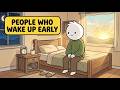
The Psychology of People Who Wake Up Early
The Bodycam Report | 2026-03-25
Description
Have you ever wondered why some people genuinely love waking up before the sun rises — and what that says about the way their mind actually works? The Psychology of People Who Wake Up Early isn't just about alarm clocks and morning routines. It's about identity, survival, and the quiet science behin...
Have you ever wondered why some people genuinely love waking up before the sun rises — and what that says about the way their mind actually works? The Psychology of People Who Wake Up Early isn't just about alarm clocks and morning routines. It's about identity, survival, and the quiet science behind why certain people need silence before the world starts demanding things from them. In this video, we go deeper than productivity culture ever will. We're not talking about hustle habits or "5 AM club" trends. We're exploring the real psychological and behavioral patterns behind early risers — where this trait comes from, how childhood environments shape it, what the latest research says about their mental architecture, and why society has consistently misread them. Here's what you'll discover in this video: Why early rising is often rooted in a need for temporal autonomy — not discipline How childhood unpredictability quietly programs certain people to seek morning solitude What Dr. Christoph Randler's research reveals about early risers and personal agency The link between morning chronotypes and lower rates of depression, backed by a 700,000-person study The hidden social and emotional cost that early risers rarely talk about Why your brain experiences the morning window as a form of psychological safety The difference between rising early out of anxiety versus natural wiring — and why it matters How to reframe your relationship with mornings using circadian science, not willpower Drawing on insights from sleep biology, developmental psychology, and behavioral research — including work by circadian health expert Céline Vetter and findings published in Nature Communications — this video gives early risers the language, validation, and self-understanding they've been searching for without even knowing it. Whether you've been waking up at 5 AM your whole life or you're just beginning to understand your own patterns, this video will leave you seeing yourself — and your mornings — completely differently. Tell us in the comments: What do you do with your early morning hours that you'd never trade? We read every response. 🔖 REFERENCES Randler, C. (2008). Morningness–eveningness and satisfaction with life. Social Indicators Research, 86(2), 297–302. https://doi.org/10.1007/s11205-007-9139-x Vetter, C., et al. (2021). Genome-wide association analyses of chronotype in 700,000 individuals provide insights into circadian rhythms and disease. Nature Communications, 12, 1969. https://doi.org/10.1038/s41467-021-22generic Porges, S. W. (2011). The Polyvagal Theory: Neurophysiological Foundations of Emotions, Attachment, Communication, and Self-Regulation. W. W. Norton & Company. Walker, M. (2017). Why We Sleep: Unlocking the Power of Sleep and Dreams. Scribner. (Population-level sleep behavior and mental health outcomes) Bowen, M. (1978). Family Therapy in Clinical Practice. Jason Aronson. (Foundational framework on adaptive childhood behavioral blueprints) American Academy of Sleep Medicine. (2020). Social jetlag, chronotype, and cardiometabolic risk. Journal of Clinical Sleep Medicine, 16(9). https://jcsm.aasm.org Fleeson, W., & Gallagher, P. (2009). The implications of Big Five standing for the distribution of trait manifestation in behavior. Journal of Personality and Social Psychology, 97(6), 1097–1114. ⚠️ DISCLAIMER The content in this video is created for educational and informational purposes only. It is not intended to serve as professional psychological advice, diagnosis, or treatment. The psychological concepts, research findings, and behavioral patterns discussed are drawn from published academic sources and are meant to support self-reflection and general awareness — not to replace guidance from a licensed mental health professional. If you are experiencing sleep disorders, anxiety, or emotional distress, please consult a qualified healthcare provider.
Tags
Transcripts
AddResources
AddCharacters
AddNotes
AddQuick Actions
Event Details
EditStats History
| Date | Views | Likes |
|---|---|---|
| 2026-10-17 | 207 | 6 |
Danger Zone
These actions cannot be undone.