Channel operation
- Elapsed time
- 0s
- Estimated remaining
- Estimating…
No changes saved yet.
Keep this page open while work is running. Estimates change with channel size; leaving may interrupt unsaved work.
View results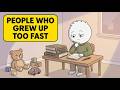
The Psychology of Kids Who Mature Too Quickly
The Bodycam Report | 2026-03-17
Description
The Psychology of Kids Who Mature Too Quickly isn't just a topic — it's a mirror for millions of adults who grew up feeling like they were born in the wrong era, carrying weight that was never theirs to hold. If you were the child who read the room before entering it, who took care of others before ...
The Psychology of Kids Who Mature Too Quickly isn't just a topic — it's a mirror for millions of adults who grew up feeling like they were born in the wrong era, carrying weight that was never theirs to hold. If you were the child who read the room before entering it, who took care of others before anyone thought to take care of you, or who heard "you're so mature for your age" more than you heard "how are you doing today" — this video was made for you. In this video, we go deep into the psychological, neurological, and emotional roots of early maturity — why it develops, what it costs, and what it quietly reveals about the hidden strengths of those who lived it. Drawing from real research in developmental psychology, attachment theory, and neuroscience, we unpack why growing up too fast is never just a personality quirk. It is a carefully designed survival response — and understanding it changes everything. Here's what you'll discover in this video: Why children in emotionally unpredictable households develop hyper-awareness as a nervous system response The concept of parentification — what it means when a child becomes the emotional caregiver for adults How Dr. Stephen Porges' Polyvagal Theory explains why your body never fully learned to rest The groundbreaking work of psychologist Alice Miller on emotionally gifted children and what drives their brilliance Why adults who matured too quickly often struggle to receive care, even when they give it endlessly The hidden connection between early maturity and exceptional empathy, leadership, and relational intelligence How to reframe your story — from one of loss to one of quiet, undeniable strength The one word that replaces every label society ever gave you This isn't a video about what went wrong. It's a video about what was built — and why the person you became is far more extraordinary than you were ever told. Whether you're on a healing journey, deep in self-discovery, or simply trying to understand why you feel so different from the people around you — stay until the end. The last few minutes might be the most important thing you hear today. Drop a comment below and tell us: when did you first realize you grew up too fast? Your answer might be exactly what someone else needed to read. 📚 REFERENCES Porges, S. W. (2011). The Polyvagal Theory: Neurophysiological Foundations of Emotions, Attachment, Communication, and Self-Regulation. W. W. Norton & Company. Miller, A. (1997). The Drama of the Gifted Child: The Search for the True Self. Basic Books. (Originally published 1979) Hooper, L. M., Doehler, K., Wallace, S. A., & Hannah, N. J. (2011). The Parentification Inventory: Development, validation, and cross-validation. The American Journal of Family Therapy, 39(3), 226–241. Jordan, J. V. (2010). Relational-Cultural Therapy. American Psychological Association. (Contributions from the Jean Baker Miller Training Institute, Wellesley Centers for Women, Harvard Medical School) Centers for Disease Control and Prevention (CDC). (2021). Adverse Childhood Experiences (ACEs): Preventing early trauma to improve adult health. Retrieved from cdc.gov/violenceprevention/aces Macfie, J., Cicchetti, D., & Toth, S. L. (2001). The development of dissociation in maltreated preschool-aged children. Development and Psychopathology, 13(2), 233–254. Bowlby, J. (1988). A Secure Base: Parent-Child Attachment and Healthy Human Development. Basic Books. ⚠️ DISCLAIMER The content in this video is created for educational and informational purposes only. It is not intended to serve as professional psychological advice, diagnosis, or treatment. The psychological concepts, studies, and theories referenced are discussed in a general educational context and should not replace consultation with a licensed mental health professional. If you are experiencing emotional distress or mental health challenges, we encourage you to seek support from a qualified therapist or counselor in your area.
Tags
Transcripts
AddResources
AddCharacters
AddNotes
AddQuick Actions
Generate Transcript Not implemented
View Analytics Not implemented
Event Details
EditStats History
Latest 30 saved snapshots, oldest to newest.
| Date & time | Views | Likes | Comments |
|---|---|---|---|
| 2026-10-17 04:07:16 | 161 | 8 | 1 |
Danger Zone
These actions cannot be undone.